If you are moving to the Netherlands for work, one of the first terms you will hear is BSN, short for Burgerservicenummer. It is often described as a citizen service number, but for an expat it is more useful to think of it as the administrative key that connects your identity to Dutch public systems. Your employer, municipality, tax administration, health insurers, and many digital government services all rely on it in different ways.
That is why the BSN matters long before your first payslip arrives. It affects whether HR can complete your onboarding smoothly, whether payroll can be processed correctly, whether you can apply for DigiD, and how quickly you can move from “just arrived” to “fully set up.” If you are also comparing offers, it helps to understand the wider salary context too. Our Dutch salary calculator: estimate net salary in the Netherlands in 2026, Dutch salary tax system guide, and moving to the Netherlands expat tax guide can help you connect the paperwork to your real take-home situation.
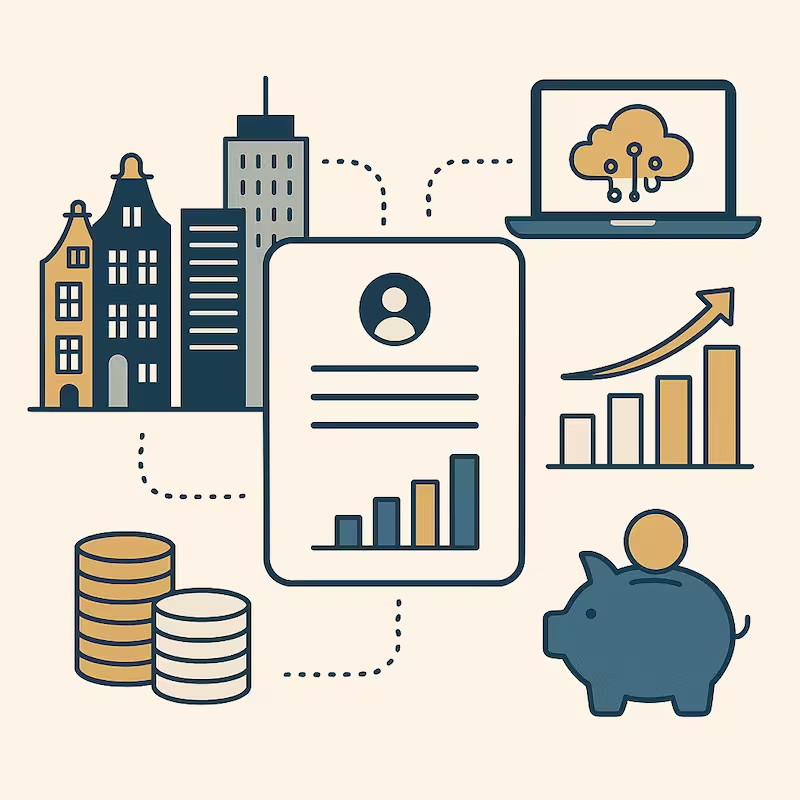
This guide explains what a BSN is, how to get it after arrival, what becomes difficult without it, and how it connects to payroll, health insurance, and digital government access. The process is not identical for every nationality, municipality, visa route, or length of stay, so treat this as a practical roadmap and always confirm your own route with the relevant official authority.
What a BSN is and why expats need it
According to the Dutch government, the BSN is a unique personal number given to everyone who is registered in the Basisregistratie Personen (BRP), the Personal Records Database. In simple terms, once you are correctly registered in the relevant public register, the BSN becomes the number the Dutch system uses to recognise you across multiple services.
For expats, that matters because the Netherlands is highly integrated administratively. Your employer may need your BSN for wage tax reporting. Healthcare providers and insurers use it to identify you in the healthcare system. Government portals use it to connect your digital account to your official records. In practice, the BSN sits at the center of work, tax, insurance, and day-to-day administration.
That does not mean every employer will refuse to speak to you until you have one. You can still interview, sign documents, and prepare for relocation before the number is issued. But the closer you get to actual payroll, tax withholding, and official registrations, the more important it becomes to have the BSN in place.
If you are arriving with a job offer, think of the BSN as the number that turns separate pieces of your move into one connected setup. Without it, you may still be able to start some steps. With it, payroll, insurance, benefits, and digital government access become far more straightforward.
Why employers care about your BSN
From an expat perspective, the fastest way to understand the BSN is through payroll. Dutch salary administration depends on accurate identity and tax reporting. Your employer needs to know who you are in the Dutch system so they can process wage tax, keep employee records aligned, and onboard you correctly. If your BSN is delayed, HR may still complete parts of the hiring process, but payroll handling can become slower, more manual, or more cautious.
This is especially important if you are trying to understand your expected net pay, tax credits, and items such as holiday allowance or the holiday allowance calculation. The administrative side and the salary side are connected. Without correct setup, the path from gross contract amount to clean monthly net salary is not as smooth as many newcomers expect.
What the BSN is not
The BSN is not just a tax number, and it is not only for employees. It is broader than payroll. It is also not proof that every other part of your move is complete. Having a BSN does not automatically mean your residence status, health insurance, DigiD, banking, or housing are all settled. It simply means your identity is now connected properly to a core Dutch public registration path.
Practical takeaway: If you are relocating for work, getting the right registration appointment quickly is usually one of the most useful early admin steps you can take. It reduces friction for payroll, tax setup, health administration, and digital government access.
How to get a BSN after arriving in the Netherlands
The exact route depends mainly on how long you will stay and how you are registering. The biggest practical split is usually this:
- Staying more than 4 months: you normally register as a resident in the BRP with the municipality where you live.
- Staying less than 4 months: you may need a non-resident registration route through the Registratie Niet-Ingezetenen (RNI).
Those are broad national routes, but the details can still vary in practice. Municipal appointment systems, accepted evidence of address, document checks, and timing can differ. Some people arrive with a work contract and a fixed address already in place. Others arrive first and complete address registration later. That is why it is worth checking your municipality’s own instructions as soon as you know where you will be staying.
Step 1: Work out whether you need BRP or RNI registration
If you are moving to the Netherlands for a long-term job, the usual route is registration in the BRP through your municipality. Once you are registered, the BSN is issued through that process. If you are only in the Netherlands temporarily, a non-resident route may be more relevant. That is one reason expats should avoid copying advice from a friend whose stay was shorter, whose visa route was different, or who lived in another municipality.
A useful rule of thumb is this: long-term residence usually points toward municipality registration as a resident, while short-term presence can point toward RNI registration. But do not rely on the rule of thumb alone if your personal situation is unusual.
Step 2: Book the appointment early
Many expats lose time here. Even if you know the process in theory, appointment availability can become the real bottleneck. Popular municipalities may have limited slots, especially during busy relocation periods. If you already have housing or a confirmed address arrangement, book the appointment as early as you reasonably can.
This matters for salary because HR teams often work backward from your planned start date. If you start work on 1 August 2026 but only try to solve municipal registration in the final days before then, you may create avoidable payroll stress for yourself and your employer.
Step 3: Gather the documents the municipality asks for
The exact checklist can vary, but municipalities commonly ask for identity documents and evidence that supports the registration. Depending on your route, that may include:
- A valid passport or identity document.
- Proof of address or permission from the main occupant if you are staying with someone.
- Birth, marriage, or family-status documents in some cases.
- Residence-related documentation if your nationality or immigration route requires it.
- Employment information or supporting papers if relevant to your broader setup.
This is one of the places where expat stories often become misleading. A municipality may accept one type of housing proof in one situation and ask for additional evidence in another. A document that worked for an EU citizen may not be enough for a non-EU arrival. A short-term serviced apartment can also create different questions from a standard rental contract.
Step 4: Attend the registration and receive your BSN through that process
Once your registration is completed successfully, the BSN is issued as part of that public registration route. The Dutch government states that everyone who registers in the BRP is automatically given a BSN. In practical terms, the municipality or the relevant registration path is what unlocks the number; you do not normally “apply for a BSN” as a separate standalone product in the way some newcomers imagine.
After that, keep the number safe and share it only where genuinely necessary. It is an important personal identifier, not something to send casually over unverified channels.
Step 5: Tell HR what stage you are at
If you already have a job lined up, keep your employer informed while the registration is in progress. A simple, practical message to HR can prevent confusion: whether your appointment is booked, whether your BSN is pending, and when you expect to provide it.
This helps because employers often sequence several tasks around your first month:
- Identity verification
- Contract finalisation
- Payroll profile creation
- Tax setup
- Pension and benefits enrolment
The more clearly you communicate your timeline, the easier it is for HR to tell you what they can complete now and what must wait until the BSN is available.
Step 6: Check the official source for your exact situation
This is especially important if your move does not fit the simplest pattern. Families, students, posted workers, non-EU nationals, people staying with friends, and people splitting time between countries can all face slightly different administrative questions. Use general expat advice as orientation, but rely on the municipality, NederlandWereldwijd, Belastingdienst, and DigiD guidance for the final answer that applies to you.
What you cannot do easily without a BSN
Some things may still be technically possible without a BSN, but they usually become slower, more complicated, or dependent on exceptions. That is the real issue for most expats. The BSN is not just about legal formality. It removes friction from systems that are otherwise hard to connect.
1. Employer onboarding and smooth payroll setup
This is usually the biggest concern for new workers. Without a BSN, your employer may not be able to complete payroll administration in the normal way. Even if a company is willing to start onboarding steps while the number is pending, delays can affect how quickly your salary records are fully set up and how comfortably HR can process your case.
If you are relocating under a package that also involves the 30% ruling, clean administration matters even more. The ruling, wage tax treatment, and relocation paperwork all work better when your core identity and salary records are aligned from the start.
2. Health insurance and healthcare administration
The BSN also matters in healthcare. The Dutch government explains that recognised healthcare providers and health insurers use the BSN. That does not mean every insurance question is solved the moment you get the number, but it does mean the BSN is part of how you are identified across the system.
For many expats, health insurance becomes one of the next urgent tasks after registration and work start. If you are subject to Dutch health insurance rules, delaying the broader setup can create stress you do not need.
3. DigiD and online government access
If you want to manage Dutch administration online, DigiD is the next major step. DigiD is the digital identity system used to access many government services. Without the right underlying records, moving into that digital layer is harder. In practice, the BSN and your registered details are what make DigiD feel useful rather than abstract.
Once DigiD is active, many routine tasks become easier: checking official correspondence, managing certain municipal matters, handling tax-related administration, and interacting with public systems without repeated paper-based steps.
4. Benefits, allowances, and linked administrative services
The Dutch government also connects the BSN to areas such as healthcare benefit, housing benefit, and childcare-related administration. Not every expat will use these immediately, but if your household later qualifies for any Dutch allowance or benefit, proper BSN-based registration matters.
5. General “life admin” momentum
Expats often describe the first weeks in the Netherlands as a chain reaction. One task unlocks the next. Without a BSN, that chain moves more slowly. You can spend a lot of time explaining that you have a contract, that you have arrived, that an appointment is pending, and that your registration is “almost done.” Sometimes that works. Often it just creates extra admin loops.
How BSN connects to payroll, health insurance, and digital government access
This is where the BSN becomes more than a number. It becomes the bridge between arrival and normal life.
BSN and payroll
Your employment contract may state a gross monthly salary, holiday allowance, bonus structure, pension contributions, and travel reimbursement. But before those terms become a functioning payroll profile, your employer must set you up correctly in the Dutch administrative system. The BSN is a central part of that setup.
That is why expats who are budgeting their move should look at the practical side, not only the headline salary. Your first question is not just “What is my gross?” but also “When will my payroll be fully live?” If you want a better sense of how Dutch gross figures turn into monthly net income, use our Dutch salary calculator: estimate net salary in the Netherlands in 2026 and read the salary tax system guide.
BSN and health insurance
The Dutch government’s health insurance guidance makes a second important connection: whether you are required to take out Dutch health insurance depends on your situation, especially whether you live or work in the Netherlands under the relevant rules. Once you are in scope, the practical setup usually goes more smoothly if your BSN and registration details are already in place.
For many expats, the sequence looks like this:
- Arrive and secure the correct registration path.
- Receive the BSN through BRP or the relevant non-resident route.
- Coordinate employer onboarding and payroll setup.
- Arrange health insurance if your situation requires Dutch cover.
- Use DigiD for the growing list of services that move online.
That sequence is not universal, but it is common enough to be useful. The key point is that the BSN is not separate from health administration. It is part of how the system identifies you once you are in it.
BSN and DigiD
DigiD is the step that makes Dutch administration feel significantly easier. The official DigiD English section is framed as “Apply and activate,” which is a good way to think about it. Once your registered details are in place, DigiD becomes your gateway to online public services.
For expats, this matters because Dutch administration can otherwise feel fragmented. You may have one process with the municipality, another with HR, another with a health insurer, and another with tax administration. DigiD does not remove all complexity, but it gives you a practical digital entry point once your identity data is properly connected.
BSN and your wider salary planning
For newcomers, salary planning is not only about the gross figure in the contract. It is also about whether your first months in the Netherlands run smoothly. If registration is delayed, payroll setup becomes slower, your first payslip may be harder to verify, and other parts of your admin life can lag behind. That is why the BSN belongs in the same conversation as take-home pay, tax rules, holiday allowance, and the 30% ruling. It is part of the real-world path from offer letter to stable monthly net income.
A practical first-month checklist for expats
If you want a simple action plan, start here:
- Confirm whether your stay is long-term resident registration or a shorter non-resident route.
- Book the relevant appointment as soon as your address situation allows.
- Check the municipality or official registration source for the exact document list.
- Tell HR when your BSN appointment is scheduled and when you expect to receive the number.
- Once registered, store your BSN carefully and provide it only where needed.
- Move next to DigiD and health insurance, based on your personal situation.
- Use the salary and tax guides on this site to understand how your contract will work in practice.
Common mistakes to avoid
- Assuming all municipalities work the same way: national rules matter, but local practice still affects timing and document handling.
- Waiting too long to book: appointment delays can ripple into payroll stress.
- Using another expat’s checklist as if it were universal: nationality, family status, address type, and visa route can all change the process.
- Treating the BSN as only a payroll issue: it also links to healthcare, benefits, and digital government use.
- Forgetting the next steps: BSN is foundational, but DigiD and insurance are often the very next practical moves.
Important note: This guide is informational and practical, not legal or tax advice. Calculations, timelines, and registration expectations can vary by municipality and personal circumstances. Always verify the latest official rules before relying on any checklist.
Final takeaway
For expats in the Netherlands, the BSN is one of the most important early setup tasks because it sits at the meeting point of work, tax, health administration, and digital public services. You do not need to panic if it is still pending during the very first part of your relocation, but you should treat it as a priority rather than a background detail.
The smoother your BSN process is, the smoother the rest of your Dutch admin life usually becomes. Payroll setup is easier. Health insurance is easier to connect properly. DigiD becomes the next logical step instead of another mystery acronym. And once those pieces are in place, you are in a much better position to understand your contract, your net salary, and your broader expat tax picture through our guides on the Dutch salary tax system, moving to the Netherlands, and the 30% ruling.